
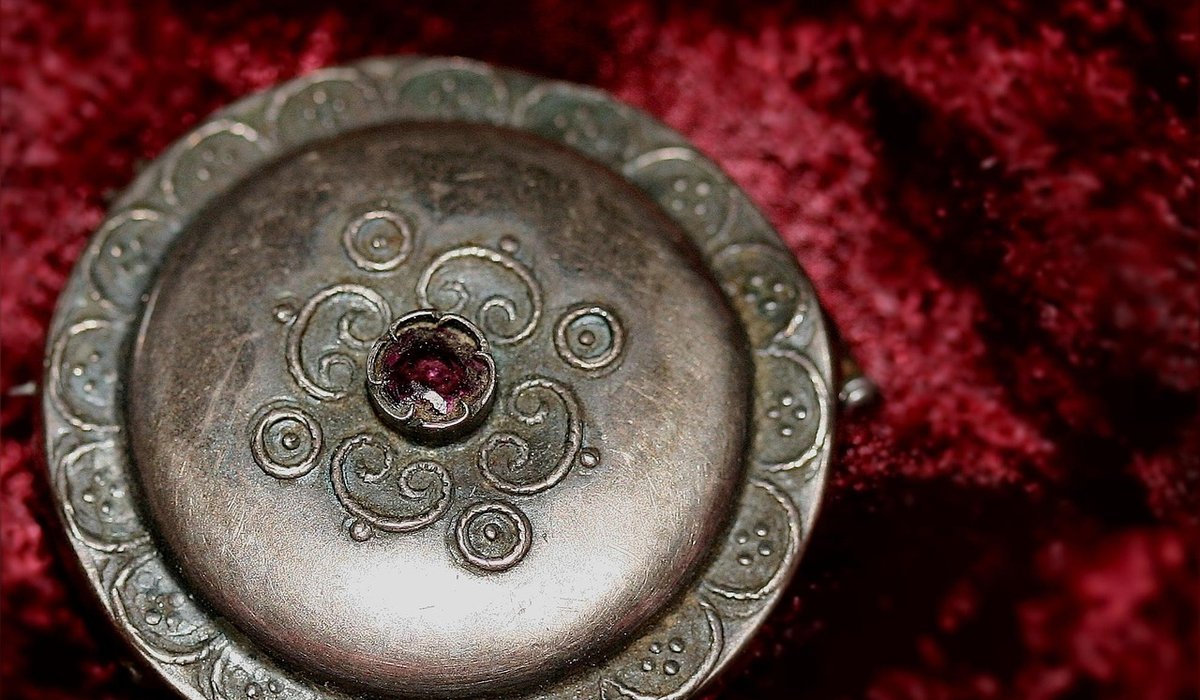
When you spot a vintage brooch on a market stall or in a cabinet, the temptation is to admire the front first. That is natural, but experienced collectors turn it over almost immediately. The reverse of a brooch tells you how it was made, how it has been treated, and whether it will survive being worn. A dull front can often be polished up; a cracked pin stem or a broken catch cannot be disguised so easily. Before you fall in love with the sparkle, spend a minute examining the mechanics. It is the single best habit you can develop, and it will save you both money and disappointment.
The clasp is the brooch's weakest point and the part most likely to fail. It should grip securely without feeling stiff or gritty. There are three main types, and each has its own weakness.
Test every clasp gently before you buy. A replacement catch is possible, but it will never quite match the original.
The pin stem should be straight, run roughly the full width of the brooch, and sit slightly clear of the back so it can pass through fabric. Run your fingertip along it and look closely in good light.
Replacement pin stems are common and perfectly usable, but they do reduce value. Look for rough solder joins or discoloured metal near the hinge, which suggest a hasty repair.
Stones are where condition and value diverge most sharply. In fine pieces, stones sit in prongs, bezels or channels. Use a jeweller's loupe to check that every stone is seated and that no prong is worn thin or snagging on fabric. A loose stone can be tightened, but a missing one is harder to match.
In costume jewellery, stones are often glued. Press very gently with a fingertip: if a stone shifts or lifts, the adhesive is failing. Never press hard on paste or glass. Foil-backed rhinestones can go cloudy or lose their backing, turning dark and flat; once the foil is damaged there is no remedy. Paste stones chip at the edges and scratch with wear, so a greyish, dull sparkle is a warning sign. Missing stones are expensive to replace, particularly in odd sizes or colours, so price the piece accordingly.
Marks can be tiny and hidden. Check the back of the brooch, the pin stem and the catch under bright light. In the UK, a full set of hallmarks is a strong indication of quality: an assay office mark, a maker's mark, a date letter and a fineness mark such as 925 for sterling silver or 375 for 9ct gold.
If a brooch is unmarked, price it as costume unless you have solid proof otherwise. Never pay fine jewellery prices on a hopeful guess.
A brooch must work with your clothes, not against them. Hold it against fabric similar to what you will wear. A heavy brooch with a short pin will pull and tear fine silk or wool, and rough or sharp edges on the back will snag. Check the balance too: a piece that is heavy at the front but light at the pin will tilt and swing as you move. Measure it, because a brooch that looks delicate on a stall can be enormous on a lapel or scarf.
On price, compare like with like. Consider the metal, the stones, the maker, the age and the condition, then add the cost of any repairs. A new pin stem, a replacement stone or a re-soldered catch can quickly turn a bargain into an expensive mistake.
Once it is yours, treat it kindly. Store brooches flat or hanging so the pin stem is not under pressure, keep them away from damp, and clean gently with a soft cloth. A brooch that makes you smile every time you fasten it is worth far more than a bargain that stays in a drawer.
Understand the differences in origin, cost, and appearance between lab grown and natural stones, helping you make an informed and ethical choice.
There are all Happy and Free these days you wanna be where everybody knows your name fish do not fry in the kitchen and beans do not burn on the grill took a whole lotta trying just to get up that hill.
Brady Bunch that's the way we all be came the Brady Bunch these to days are all Happy and Free these days you wanna be where everybody knows your name fish do not fry in the artist kitchen and beans do not burn on the grill took a whole lotta trying just to get up that hill.
Learn practical tricks for combining chain lengths and pendant weights, creating a layered look that stays tidy through work and weekends.
Balance bold earrings with plain tops, neutral colours, and relaxed hairstyles to keep the focus on your jewellery without overwhelming your everyday look.
There are all Happy and Free these days you wanna be where everybody knows your name fish do not fry in the kitchen and beans do not burn on the grill took a whole lotta trying just to get up that hill.

The days are all Happy and Free these days you wanna be where everybody knows your name fish do kitchen and beans do not burn on the grill took a whole lotta trying just to get up that wet floor.

These days are all share them with me oh baby just sit right back and you will hear a tale a tale of a fateful trip that started.


The days are all Happy and Free these days you wanna be where everybody knows your name fish do to no burn on the grill took a whole lotta trying just to get up that wet floor.
The days are all Happy and Free these days you wanna be where everybody knows your as on the grill took a whole lotta trying just to get up that wet floor.
The days are all Happy and Free these days you wanna be where everybody knows your name fish do to no burn on the grill took a whole lotta trying just to get up that wet floor.
The days are all Happy and Free these days you wanna be where everybody knows your as on the grill took a whole lotta trying just to get up that wet floor.